
How to Draw a Shoe Step by Step (Sneaker)
This beginner-friendly tutorial shows how to draw a shoe. It provides simple illustrated examples and easy-to-follow instructions.

The example is of a low-profile sneaker, also known as a “lifestyle sneaker,” drawn from the side view. The shoe features a minimalistic design with an orange, blue, and white color scheme.
The tutorial demonstrates an effective approach to drawing footwear starting with its main parts and gradually adding the smaller details and various design elements.
It’s recommended that you start in pencil and make light lines as you will need to do some erasing when adding the shoelaces. You can trace over your drawing with a black marker or darker pencil lines once you’ve added all of the shoe’s parts.
For drawing a matching accessory, see:
How to Draw Socks Step by Step
What You Need to Draw This Shoe
- Regular graphite pencil: For the initial outline drawing.
- Standard eraser: To clean up the drawing and correct mistakes.
- Colored pencils or markers: Orange and light blue.
- Paper: A white sheet of paper.
- Black marker (optional): To create a black outline.
Step 1 – Draw the Sole of the Shoe

Start by outlining the sole of the shoe. Make it narrower at the front and wider as it goes towards the back. Draw its overall shape with a bit of a curve (especially near the front).
Step 2 – Outline the Overall Shape of the Shoe’s Upper Section

On top of the sole, add the overall outline of the shoe’s upper section. Draw this curving up from the toe into an upward slope. This should then dip down around the opening and gradually curve up toward the back before dropping down to the sole. This outline should essentially just be a silhouette, without any of the smaller details.
Step 3 – Outline the Different Sections and Design Elements

Add the smaller parts and different design elements as shown above. Start by adding the tongue coming out of the shoe’s opening. Next, outline the area for the laces (the eyestay), followed by the toe cap and heel counter (at the front and back of the shoe).
Finally, add the stripe along the side and the outsole along the very bottom.
Step 4 – Draw the Shoelaces and Eyelets

Running along the upper/front area of the shoe, add the shoelaces. As mentioned at the start, you will need to erase bits of the shoe’s outline when adding these in.

A very helpful trick you can use for spacing the lace segments is to start by drawing the first and last. Afterwards, add the segment in the middle, followed by the ones in between.
If you simply draw them all in a row, you might find that by the time you get from the first segment to the last one, they don’t properly fit on the shoe.
After you’ve outlined the laces, add the eyelets (little metallic rings) around the holes that they go through.
Step 5 – Draw the Stitches Along the Edges of Various Sections

For this fairly simple step, add the stitches. Draw these as dashed lines that run close to the edges of each of the parts outlined in the previous step. Also, add stitches along the shoe’s opening (as shown in the example).
As the stitches pretty much follow the shapes of the different parts of the shoe, you should check to make sure that you are happy with how each of those looks before adding them. You can then make some very light lines (barely visible) to act as guides and draw the dashes along those using a black marker or darker pencil strokes.
Once you’ve added the stitches, darken the rest of your lines as well.
Step 6 – Apply Your Shoe’s Color Scheme
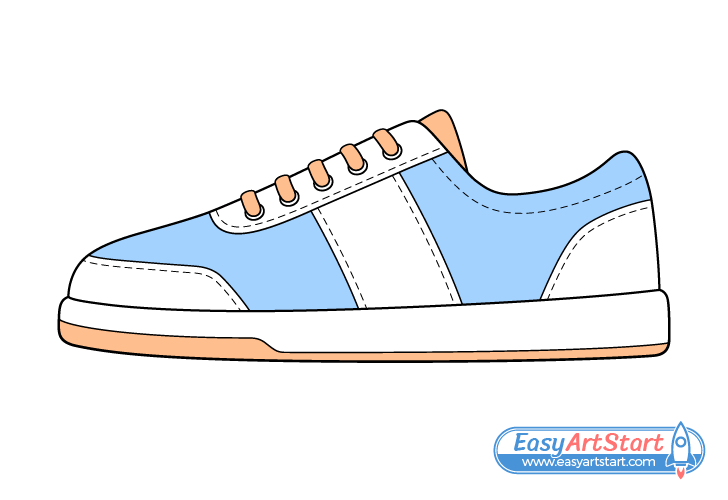
To color the shoe, you can use just about any color scheme you like. As already mentioned, in this example, it’s blue, white and orange. These colors tend to go well together and can help further emphasize the sneaker’s design.
If you are going to be following the example, color as follows:
- Shoe (main body): Blue
- Tongue: Orange
- Shoelaces: Orange
- Eyestay: White
- Toe cap: White
- Heel counter: White
- Side stripe: White
- Sole: White
- Outsole: Orange
You can, of course, just use the white of the paper for the white areas (if drawing on regular paper).
Conclusion
This tutorial shows how to draw a lifestyle sneaker in six simple steps, going from its main parts down to the smallest details.
Working from larger to smaller shapes is a good approach to art and can be helpful for drawing all kinds of footwear.
If you like these kinds of easy-to-follow, step-by-step guides, also be sure to try the following: